Excerpt from transcription, audio
recorded on Sunday, March 16, 2025
Ameer: Can each of you introduce yourselves?
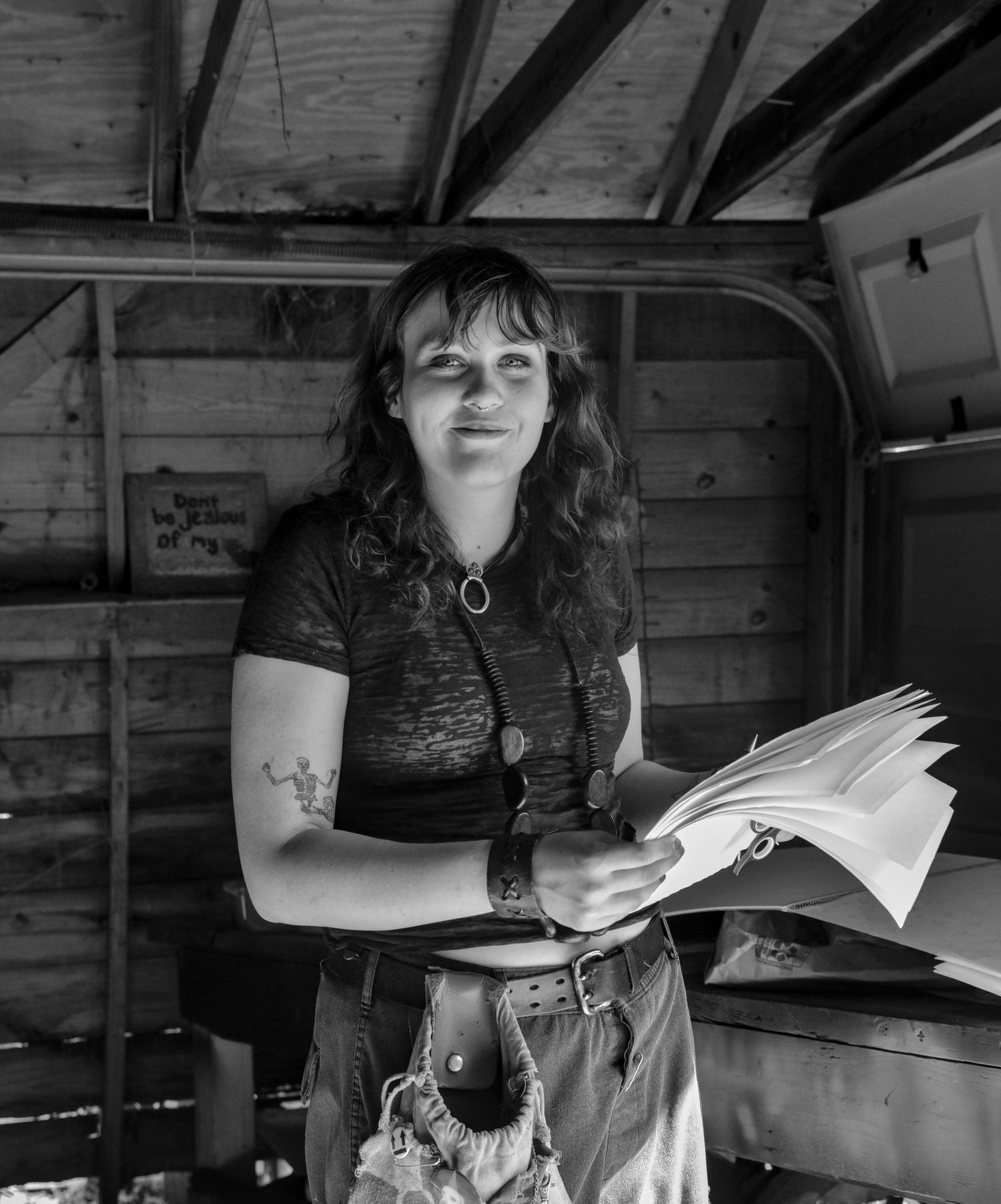
Lillian: Alright, yeah. I'm Lillian. I'm 20. I live at House of J. I do art—visual—a little painter. Yeah, that's pretty much me.
Ameer: So, how did you get into the scene?
Lillian: So, in high school, I lived in, like, the League City area, so everybody's kinda, like, conservative and weird. I just didn't fit in, even though, like, alternative people were there. It was just, like—not—it was not the same.
And so when I started coming to shows, I started coming with mutual friends of mine who also enjoyed the same stuff. And yeah, I think I was in Galveston, and Ben—the photographer guy—yeah, he had put up, like, fucking posters with the QR code for the scene link. And I got the link, and I was, like, locked in from there. I was like, okay, so I have to go to this shit.
I have to put my little fit on—like, found my people. [laughter]
Ameer: When I interviewed a lot of other people—which hasn't been too many so far—but when I have, everyone has talked about how much they love House of J. So I just wanna ask: what motivates you to make this place a very, like, inclusive, safe space for anyone?
Lillian: So, personally, I've had issues with other venues, like Trip Six. [Laughter]
And, like, whenever I started going to shows and stuff, I just, like, was looking for community and a space that had the music and art that I like—because there aren't spaces like that, really. You really have to find them if you're any type of alternative or queer person. And the problems that were happening with the other venues I was going to were, like, really heavily related to just not keeping people safe.
And I know that a busy space can get uncontrolled, but when you have people directly reporting stuff to you and you're not handling it, that's just like—you're causing the environment that you're in. So whenever I moved into House of J, I really tried to make it a point of, like, we're putting all these rules in place. We're keeping people safe. Because I've had people come to me and say that they've had bad experiences with people here, and I don't want that. I never want somebody to get hurt in my home.
I always want it to be a safe space. So, like, really, it was just that—trying to keep everybody safe a little bit, trying to have a chill spot where nobody feels like something bad's gonna happen.
Because I love some of the other venues in Houston, but it's just—it's not the most welcoming environment, you know?
And we try to be as open as possible so that those people that are coming in new and fresh and don't know what's going on—they feel okay, and they're not, like, fucking scared of some old creepy guy or some drunk stupid person.
Like, yeah. Just mainly that.
Ameer: What do you want people, like, outside of the Houston, Texas community to understand?
Lillian: So, really just that, like, community space is important.
There’s this cool website that just popped up called Freak Scene.
They’ve been trying to connect all the, like, scenes in all the states in America and stuff—just trying to make it easier for people to get involved and, like, do music, vend, or do stuff like that.
So I just, like, I want people to understand how important community is—and that you kinda have to make it yourself. Like, you can’t go to a gentrified coffee shop and get the same experience as, like, going to House of J and meeting real people, you know? Because all of the other places that aren’t DIY, you know, they kinda have this corporate-centered mentality to it, where all they care about is making money and getting their bills paid and stuff like that. And it’s not focused on the people who are attending.
So I feel that, like, just community in general is important—no matter if you’re, like, alternative, or you’re a fucking hippie, or you have something else going on.
Like, you kinda have to make your own space.
Ameer: Do you think that, I guess, DIY culture is more ingrained in Houston than in other places?
Lillian: I think it is, just because, like, Houston as a city has been through so much.
And, like, I feel like the South in particular is a lot more tight-knit, just people-wise—especially amongst, like, any diverse communities, you know? They tend to have each other’s backs more than the North—not gonna lie.
But I feel like Houston is just, like—everyone, most of the time, is pretty welcoming.
There’s just kind of that attitude of, like, "You be nice to people before you’re a fucking dick." So I feel like that helps out the DIY aspect in a way, because it’s bringing that welcoming vibe that we’re all trying to get out there.
Ameer: So, just about the scene in general — do you think the Houston scene has something special?
Lillian: I think they definitely have something special in, like, the artists that come out of Houston. I feel like there's a lot of people that start in Houston and are, like, supported by the music scenes — that end up doing really well. Like, Salvinorin-a — their first show was here. Like, they got inspired to do music based on seeing bands at House of J. And I feel like Houston does have something special in that sense, because we are more welcoming to, like, other people.
We try to bring as many people as possible, no matter if you fucking wear spikes or if you're in a T-shirt. And I feel like some other places can be more divided just based on aesthetics and not based on personality — and, like, what you're there to do. So I feel like Houston’s got something special in that regard.
Ameer: What do you want people in the community to understand about you as an individual?
Lillian: I'm here for all the gays, theys — everybody. Like, I will sit here and call people out. Like, I won't take no fucking bull. Don't have it in my yard. Don't have that bullshit in my face.
Like, I'm not — I'm not gonna sit here and look at it or deal with it. And I feel like I've already kinda made that known, but it's something that I want people to know. Like, if anybody ever needs anybody to reach out to in the scene — if they want advice or they have a situation — like, I've been in way too many situations that I can count. And I got way too much knowledge for my little 20-year-old brain to hold on to, so I gotta give it to somebody else. I feel 45. I feel 45 years old in my mental brain.
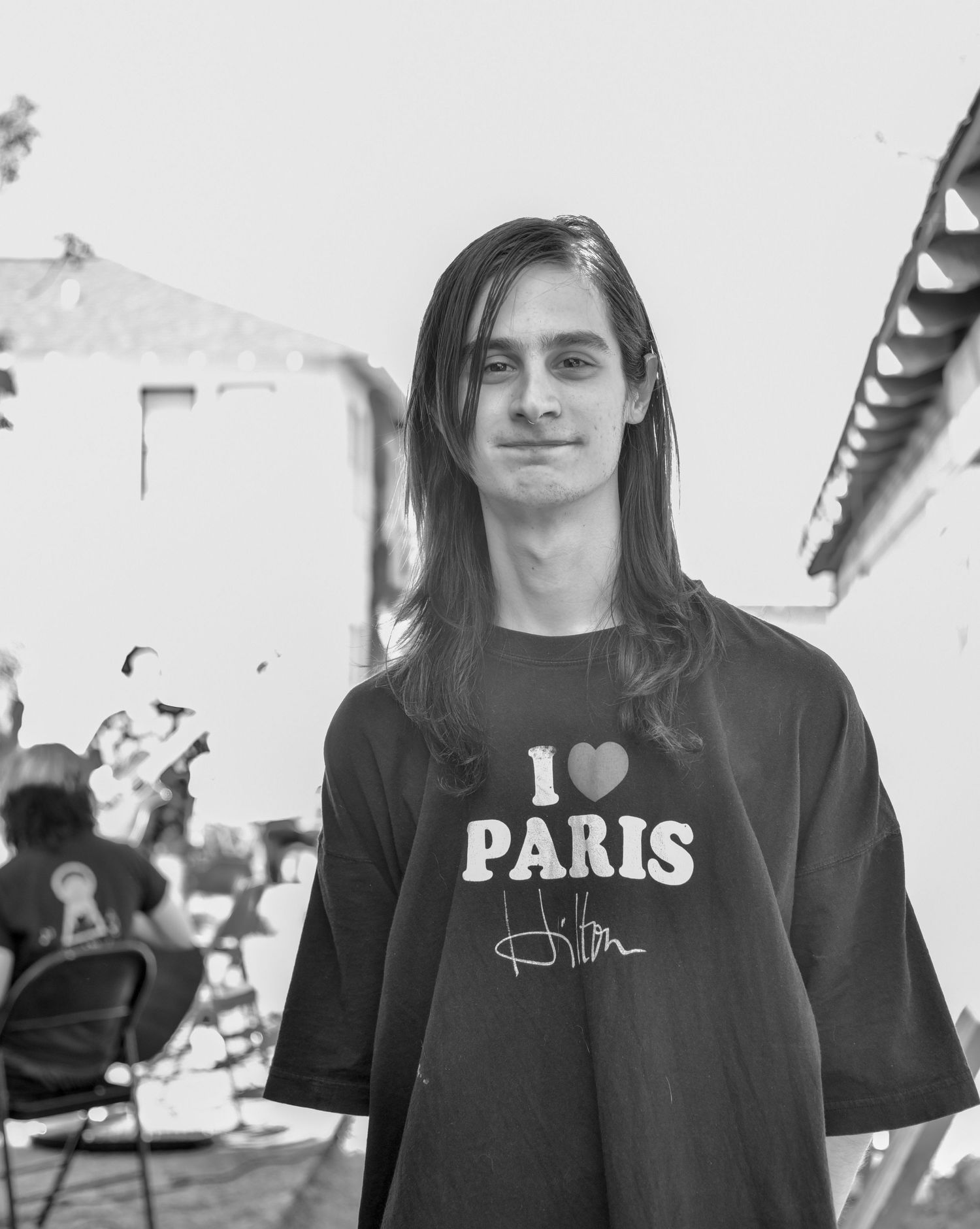
Pepin: I'm Christian, also known as Pepin. Like, pretty much everyone calls me Pepin. 21. I used to be in a band, so I'm trying to get some stuff going with music. I'm not too much of a visual artist. I'm more inspired by music. Yeah. Not doing anything currently, but I'm always there for people, you know what I mean? I try to help them out with their sound and their shows.
Ameer: First question is, how did you get into the scene?
Pepin: So, yeah, I have a friend, Jerry. We love Jerry. He was just basically always trying to harass me to get me to shows. And he sent me a Free AF flyer, and I was like, "Oh, I don't have money for this." He was like, "It's free." And I was like, "Okay. I can go to it."
I go to it, and it's like—well, this is awesome. I believe I met, like, people... I don't know if you know Clock Pole, but I met Clock Pole that night, and he's been a great help to me with my journey through the scene. I've met a lot of friends I know even till today.
It was a big show, almost like this one, where we had a lot of artists on the walls, and we had many musicians. Like, that one had—it was probably close to ten musicians that night. Like, it was insane. And it was just like, "This is such a magical place, and this is perfect for me."
House of J had a visual artist in front of all the bands playing. And it was, like, that mix between, like, really glitchy-type visual art that I love.
And I—the only other visual art I make is stuff like that, as well as, like, these shoegazy, weird, noisy bands. Like, they had pedalboards on the table and were bowing a big violin—a big, huge bass—on its back, making, like, big noises. And I was like, "This is exactly where I wanna be. 100%." And there have been very few House of J shows I've missed since then.
Ameer: What does this community mean to you?
Pepin: First thing I think of is family. I mean, it's my people, and people—I see not only now, day to day, but week to week, show to show—people who help me out, people I help out. We're a family that grows together, that learns together, that works together.
Ameer: What do you want people in the community to understand about you as an individual?
Pepin: I feel like, a lot of times, I come off very straightforward and rude—like kinda dickish to a lot of people especially at first, you know, when I don't really know them. It's something I'm working on. I… I most of the time never really mean it.
Ameer: So do you think that the Houston, Texas scene has something special to it compared to other places?
Pepin: Again, it's that, like, sense of family. Like, I have never been a part of any other scene, so I'm not sure if a lot of other scenes have that. I mean, I have a lot of friends that are in other places, like New York and Chicago. And it's just like—here in Houston, we really work together. We help each other out so much. Like, a lot of the things, whenever I was in my band, I would not have been able to do if it weren't for House of J—if it weren't for places like White Swan or Super Happy—where it's just like, we have Joe from Clock Pole, who was helping me get onto shows. And he offered—I never was able to take up the offer—but he offered to press and to record onto cassettes and records.
And Don from Super Happy basically just letting us go there to have shows basically whenever. I mean, I could just email him and be like, "We want to have a show on this day. We'll see you then."
And, of course, Jeffer and Johnny—they helped me out from El Jamotron, they helped me out so much with learning so much about it.
Ameer: So what was your first impression of everything when you were, like, just coming in?
Pepin: I think I came in at a weird time because I came in when I started going to shows. My first show was early December of 2022. And a lot of things happened, especially at House of J, around early 2023/mid-2023. And so, coming into here and just seeing — I feel like — almost the worst of it at House J, unfortunately. There were a lot of bad things happening in House J, unfortunately, back then. Them getting shut down, and um.. Mexican Coke — my last show I played here until they got shut down — Mexican Coke drove over, like, Stefan's foot. And it's just like, that's kinda just what the musicians were like whenever I first joined. They were not the best people. But being able to stick with it, now I'm just like, I get to see through it. And I've met a lot of people who are awesome now. I think at first I was worried about it — worried it'd be tough for me to, like, be myself. Hard to fit in. I don't see it anymore though.
Ameer: So what attracted you to the scene in the first place?
Pepin: Just being able to see all of this is awesome — the way that it, like, just brings fun into people's faces.
Ameer: What do you want people outside the Houston, TX scene to understand?
Pepin: The only shows outside of Houston that I've been to — I've gone to two big shows in Austin — and it was very corporate there. I don't know what other people see us as. I'm not sure. So, Houston can be very chaotic. And I guess if I were to tell people something, I would say Houston is very chaotic. We are insane, and we do crazy shit. It's awesome.
I just — I don't have very many — I don't have the perspective on any other scene except for Houston. I mean, if you'd like, I would like to put my own spin to my own experiences and what I would say to other scenes.
Ameer: Yeah!
Pepin: I see a lot of other scenes, and we do a lot of free shows in Houston, and that helps out a lot for the bands and for the people. Everywhere else you go, it's like $20 for doors. I went to Mohawk, and I don't even know what the other one was, because the other place I went to was just terrible in Austin. And it was, like—I don't know—it was super, like, corporate. Like, they're only there to make money. I dropped my lighter on the floor, and it was something that I'd—like, I'd marked it in a special way. I knew that this was my lighter. And I saw the door lady with it, and she was like, "Oh, it's my friend's lighter. I'm holding on to it." And I'm like, "Well, like, I can see the back of it where I—like, I did a little mark on it. I know this is mine." And she slammed it inside of her cash register and said, "It was contraband, so I took it from you."
And it's like—what? Like, that wouldn't happen here in Houston.
The $20 doors, I think, honestly, I think I paid $40 for doors for two days there. Like, both days, I paid $40 for doors for shows, which is—like, that's crazy. I think New York does it right, too. That's a scene that I—I haven't necessarily seen. I've seen it from an outsider's point of view. I've never been to any show there.
I have lots of friends who do music and go to shows there. So I see their flyers. I hear their music. Shout out Venus Twins. They're awesome. They were an old Houston band back in the day, and they're now in New York. they're fucking chaotic too. They'll do everything. I love that about Houston—that we do everything. I think, like, people should branch out. And people shouldn't be afraid to—to maybe lose money on doors so that you can have merch up. Instead, do—do more free doors like Houston, and be chaotic as shit.
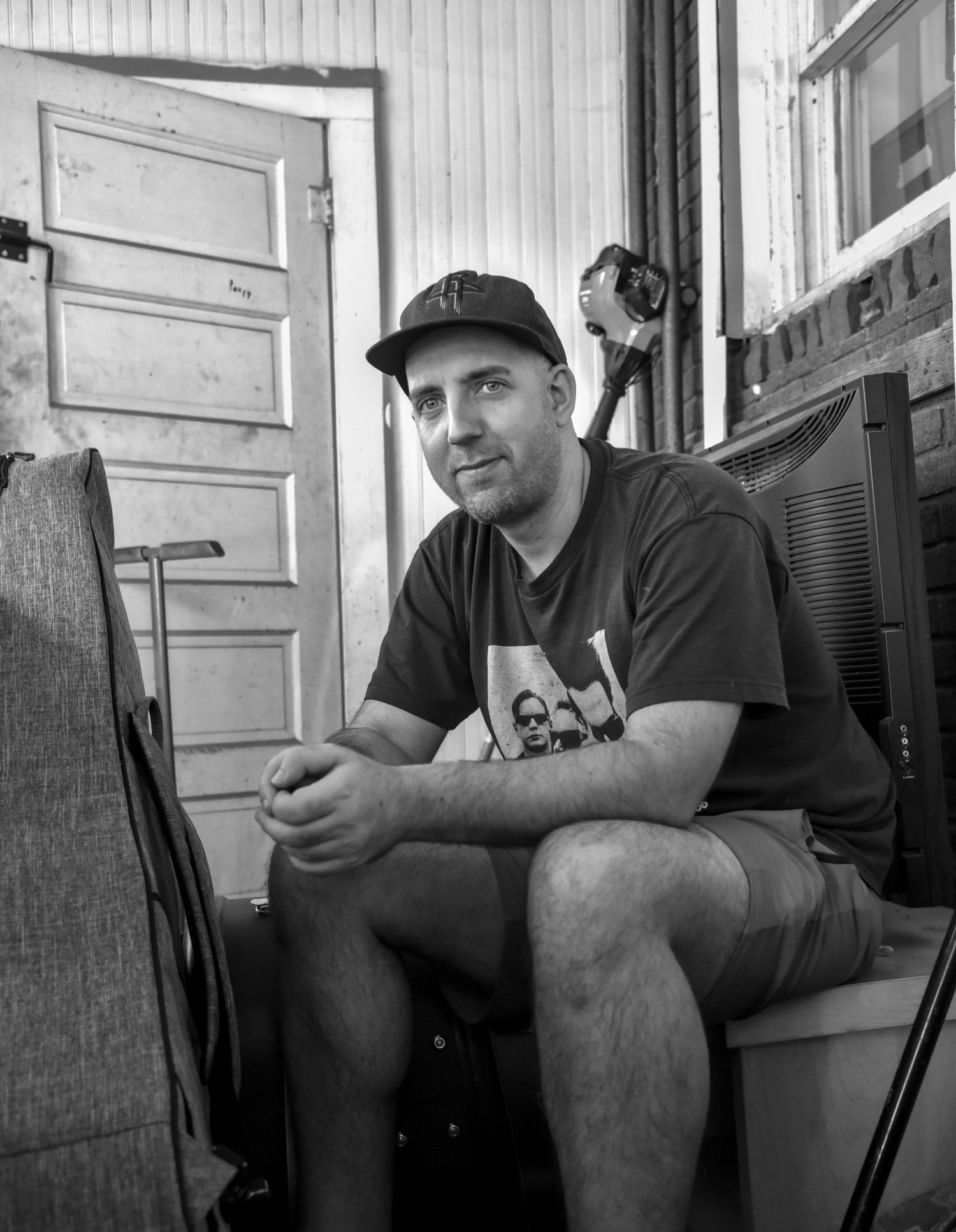
Jeffer: Yeah. I'm Jeffer Thomason, of House of J—one of the Js, the last remaining J in the house. I play in El Jumbotron. I'm from Scotland. I've been here at House of J for seven years.
Ameer: Alright. So, what is the story behind the name of House of J?
Jeffer: It started in 2018. It was me, my old roommate Johnny, and our band is EL Jumbotron. My name is Jeffer.
So Johnny was, like, throwing out all these, like, "House of blah blah blah," and I was like, "It's J, dude." Like, we're all called J. We're all just House of J.
And he's like, "Alright. Ding, ding. That’ll do."
Ameer: How did you find the place?
Jeffer: I was living a block away with a guy called Farmer Joe, and I was moving out. My old roommate Derek was also trying to rent an apartment, trying to rent a house space like this.
We couldn't find anywhere. And then, the day before my lease was up, he found this on Craigslist for, like, $1,200 a month. And it was me, my old roommate Derek, and Johnny. And yeah, it was just a miracle find, honestly.
The Craigslist landlord gave us a one-year lease back in 2017. And it's funny because they're identical twins—the landlords. The first one we had would come over and party with us all the time, and sell us weed. He lived there because he owns that apartment complex too. And it was the chillest first year.
And then he was kind of—he was kind of like the slacker of the twins.
And then, towards 2018 or 2019, I think it was, his identical brother—a conservative guy—took over. And he was like, "You know what? This neighborhood doesn’t want this place. This is a nuisance."
And I told him, "No. This is, like—this is so beloved by the neighborhoods." Like, they made a petition to keep us as a venue.
He’s like, "Alright. I’ll give you a chance." And then, five years later, he’s here, like, saying—whenever there are noise complaints, sometimes they’ll call him, the conservative landlord, and he defends us.
He’s like, "No. They’ve been here for seven years. Y’all just moved in. Like, they’re here to stay." So we've got the backing of our landlords now, so it’s really cool.
Ameer: So how did you get into the scene?
Jeffer: I was working with a nonprofit—well, volunteering for a nonprofit farm in the Fifth Ward called Last Organic Outpost, with a really cool guy called Farmer Joe. I was really inspired when I was watching YouTube videos back in, like, 2012 or 2013 about how to build community—not putting all your energy into, like, a political party or anything, but, like, building community and being a pillar of your own community.
So I came out and I volunteered at that farm for a year or two. I started, like, an open mic out there. And, you know, we brought sort of—like, I think the first open mic, we brought, like, 80 people out. It was, you know, like an acre of farming and music, and they had a cob pizza oven. It was just beautiful—the way all these elements merged together and created these beautiful moments.
Then that farm sadly went under because they couldn’t pay the taxes. So right around the same time, my friend back then, Derek, and my bandmate Johnny were looking to start a community space. Derek had been doing it for a couple of years already out in the Third Ward. He was looking for a new space and found this one on Craigslist, like, literally last minute.
So I moved out of Farmer Joe’s into here. Originally, Derek was doing not so much community music-centric stuff, but more like workshops and skill shares and that kind of thing.
When he moved out, like a year later, me and Johnny were like, “Right, we've got to rebrand.” I wanted to do everything about music—and, you know, the gardening and vendors and all this kind of stuff.
It just evolved from us doing the worst shows you’ve ever seen in your life, because we were just starting out and didn’t have a clue what we were doing. We'd get, like, maybe 10 or 20 people—including band members—to come out.
We struggled for the first six months to a year, just bombing because we didn’t know which bands to book or which bands would draw.
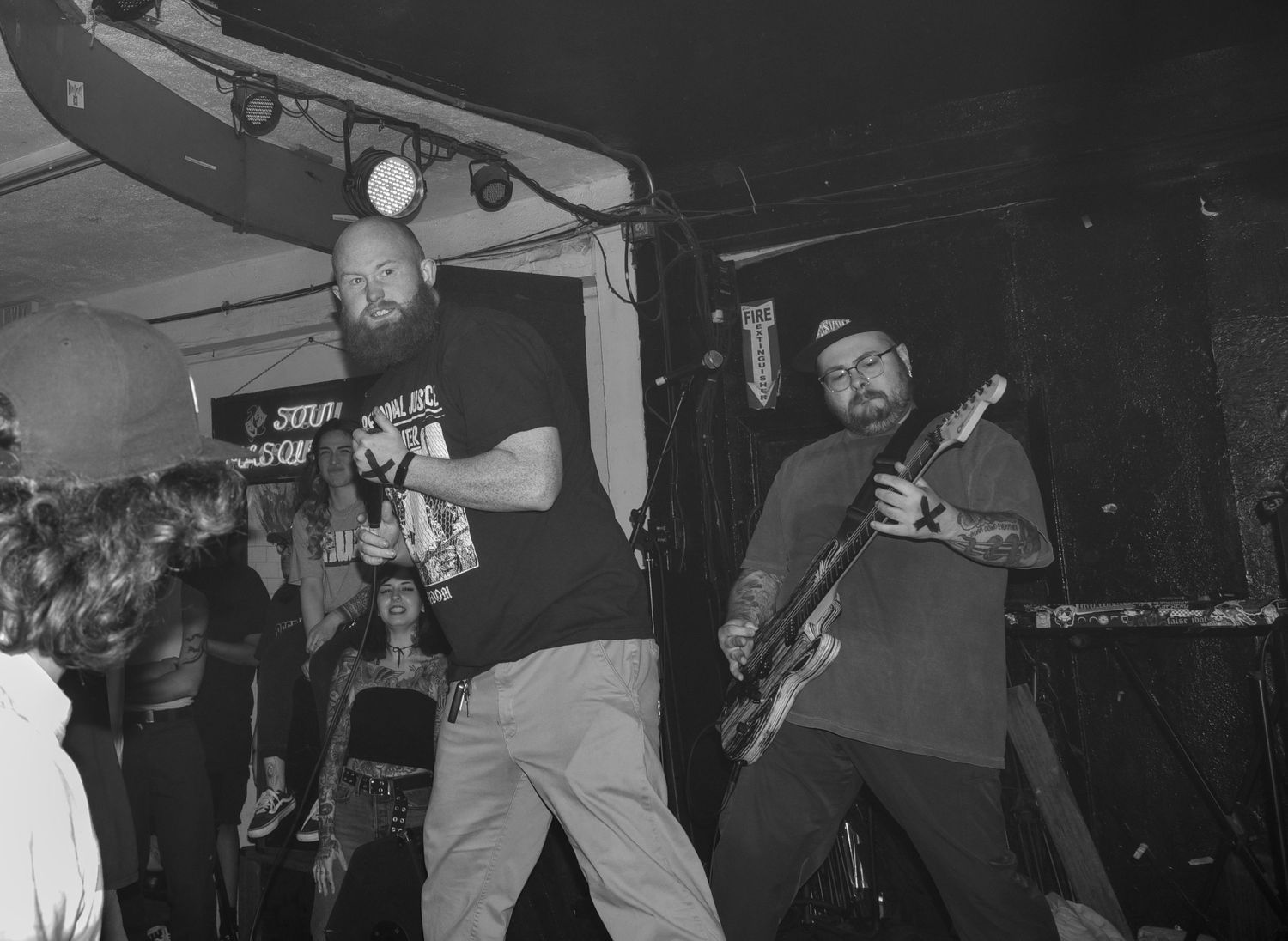
Then the hardcore kids started coming out, I think toward the beginning of 2019. The hardcore kids found out about House of J, and they brought, like, a hundred kids every show. We were like, “Holy shit. This is too big for the living room.”
Like, we were breaking the floor. That’s why when you stand in the living room, it’s like this right here—the foundation is completely just shot.
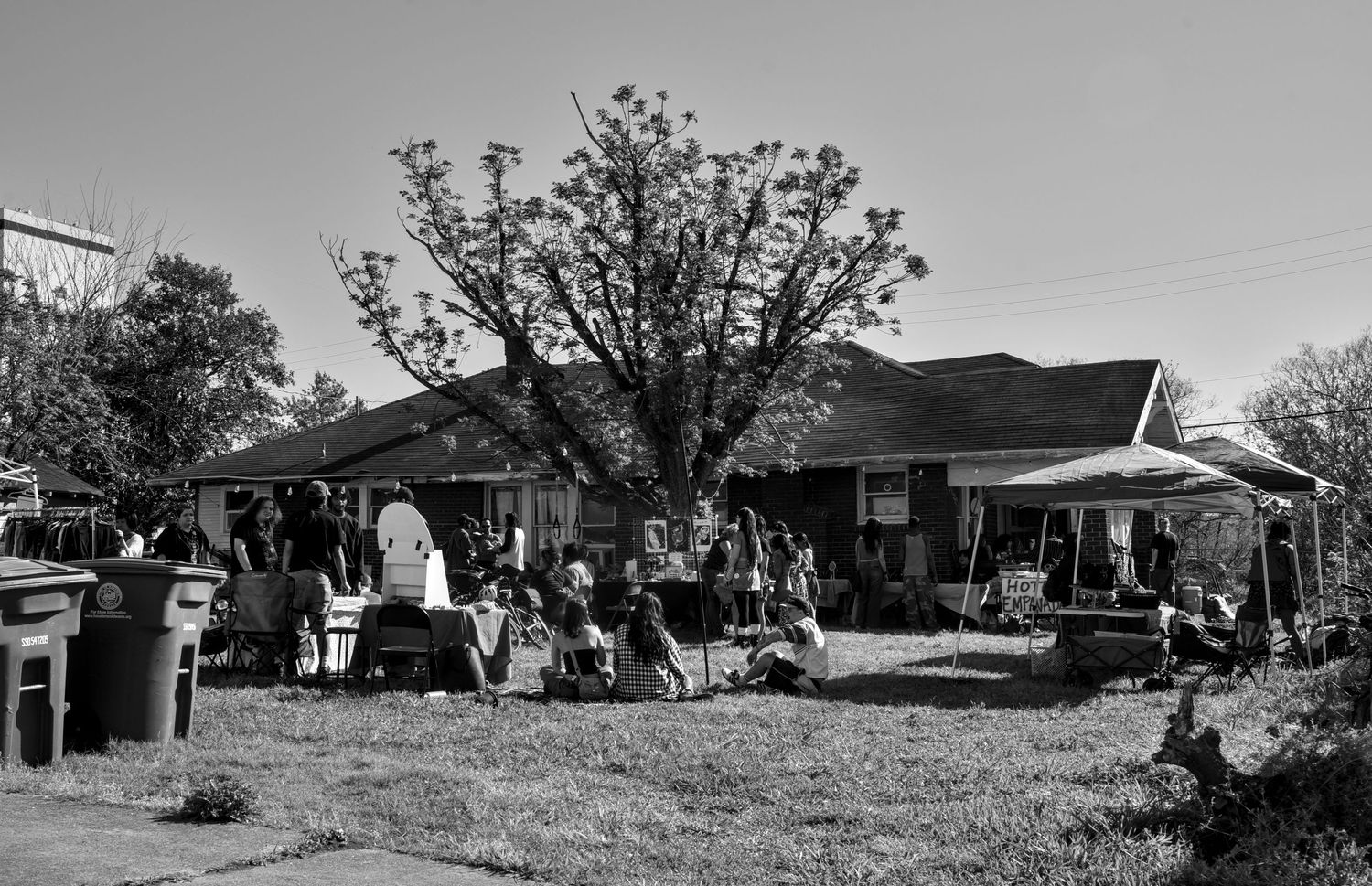
At the time when we were doing indoor shows, the garage was just a complete mess. It used to be a boxing gym or something like that. There were, like, a hundred pairs of old boxing gloves from the 1950s, and car parts, and all this shit.
So we just moved it all—it was heavy trash. We were like, “We can't do shows inside anymore. Let’s see if we can do shows out in the garage.
And that—that was, like, just an epic, epic time. Like, I think that was 2019. From the hardcore kids, we got this promoter—Derek, what's his name? Derek Rathbun—booked Narrow Head here. And that was, like, our, like, "holy shit" moment.
I think it was, like, 350 people, like, all around the yard. It was an indoor show. For some reason, we did an indoor show, and, like, people got to see Narrow Head in my living room. And that was, like, right before—or right around the same time that they signed to a, like, a fairly big label.
And now they’re touring the world or whatever. But that brought in all the other promoters who wanted to book because they saw—like—“holy shit, this is a great space.” And then COVID hit.
And then all that—all that momentum—died for, like, a year and a half. And then we came back. And then it was just, like, blast off—like, a solid two years that we had of just—every show was just... just beautiful.
I started doing Free As Fuck shows because I was like, “I don’t wanna make any money off this. I just wanna, like, grow as much community as possible.” And me and Johnny kinda had a philosophy of, like, just think about, like, what you can give to the community rather than, like, what you can get from it.
And so we’re just like, “Let’s do fucking free shows.” We’ll fund it by Patreon, and we’ll just give people free food, you know—free drinks, free workshops, all this kind of stuff. And the shows just, like, kept growing and growing and growing.
And then, sadly—was it? Yeah. It was a year and a half ago—we got too big. We’re—we're a victim of our own success because, like, the shows kept getting younger and younger and younger. Because, you know, the high school kids found out about it, and they’re like—the news just spreads so well. “Oh my god, there’s a place where you can go and it’s, like, huge shows.”
And they’re fucking impossible to manage because, like, we’re just—we’re just, like, a couple of guys. And, like, there’s 300 people in our yard, and people were—you know—they're bringing all their vices and their alcohol and shit.
And so it wasn’t that that got us shut down. It was people parking in neighbors’ driveways. And then our neighbor—who's super fucking cool, I love her to bits—but she complained to our landlord, because it happened literally four times. I would have done the same in her position.
And so the landlord was like, “Right. That’s it. No more shows.” And so, yeah—we shut down for, like, a year. And then we kinda just, like, tiptoed away. I said, “Can we try this? Can we try it, like—let’s throw a small show.”
And now he’s, like—for some reason—he's gone from “absolutely not” to being super chill with this. So right now, I feel like we’re fighting so many forces.
They don't want us to be doing what we're doing right now. But we're just like—because we've got the floor that's broken, the roof is leaking. Look, it's patched up there. The garage is leaning over. The neighbors are calling the cops.
It just feels like all these different angles are saying, "Okay, no more, no more." But we're like—it’s worth it. It's worth it.
Ameer: What do you want people outside of the Houston, Texas community to understand?
Jeffer: Understand that, you know, if you—like, you just have to—you can make a... I don't know. That it's possible. Like, yes, we've, like, flown by the seat of our pants for the last few years. And, you know, it's kind of a miracle that we got this house, and it's such a great space. And it's literally only, like, $1,350 a month. And, you know, other cities might not have that opportunity. There might be, like, HOAs and all that kind of stuff. But if you do DIY—do run a DIY space—it just creates so many amazing opportunities to, like, connect with people, to give opportunities to other people, and, you know, just try to be a pillar of your community.
Ameer: What do you want people in the community to understand about you as an individual?
Jeffer: That I'm trying to build community and inspire others to replicate it. Like, one thing I really hate about superhero movies—and this is a, you know, giant segue or whatever the word is—is I hate, like, the hero is always just this guy who saves the world, and then it's like everyone depends on them. And I wanna create—like, I feel like if you're Batman or Superman or whatever superhero—you should be creating other heroes.
And I just wanna show people, like, just do it. Just be someone who dives into, like, "What can I give the community?" And then what you get back is, like, a hundred times more than what you put in. If your intentions are good and you're, like, legit just trying to give people opportunities, then that—yeah. You have to have boundaries. You can't just get walked over.
But if you have, like, the courage to be a pillar of your community, then I feel like it's just a great place to position yourself in life, because you surround yourself with cool people.
Yeah. I want people to become pillars so we can build a really cool community. And, like, Lillian right now is absolutely stepping into that role. I'm sure Pep will—he's only been here a month—but, like, it's just so cool seeing Lillian go from being a vendor for a couple of years to, like, seen as the scene mom.
She's just like this—like she's the human version of this dog called Scrap. She's the guard dog. She's awesome. And she's just becoming this pillar of the community, and, like, someone who's, like, really well respected.
And I just wanna build a team around me that's, you know, that kind of people—that kind of person.